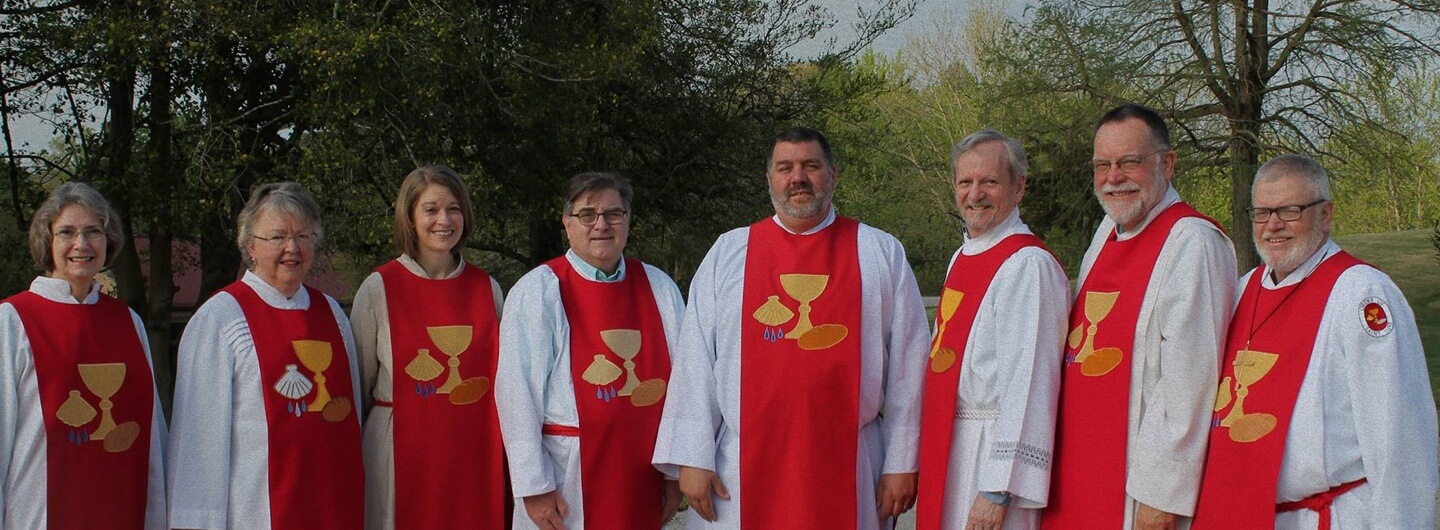
Living the Rule: Beginning Steps
Br. Matthias Tanner, OSL
Copyright © 2022 The Order of Saint Luke
All Rights Reserved
The Order of Saint Luke is a religious order
dedicated to sacramental and liturgical
scholarship, education and practice.
The mission of the publishing ministry is to put
into the hands of students and practitioners
resources which have theological, historical,
ecumenical and practical integrity.
TABLE OF CONTENTS
Introduction
Some Key Words
Sections of The Rule (with Suggestions and Questions)
1. We Affirm the Apostolic Hope
2. We Live for the Church of Jesus Christ
3. We Seek the Sacramental Life
4. We Promote the Corporate Worship of the Church
5. We Magnify the Sacraments
6. We Accept the Call to Service
7. Resources
8. Postscript
Introduction
Q: How do you get to Carnegie Hall?
A: Practice … practice … practice!
Carnegie Hall, in New York City, is a concert hall with very good acoustics, and it is regarded as a place where only the best musicians perform. So, to play at Carnegie Hall as a soloist or part of a group is an indication that a performer is highly regarded by those whose knowledge and experience has placed them in a position to make such a judgment. It is a privilege and a mark of distinction. There is humor in that Q and A, and there is truth, too. No performer picks up their instrument for the first time and hops in a cab to go to perform at Carnegie Hall. They get there through long years of study and performing … and, yes, lots and lots of practice.
This is the reality for any human endeavor. Some may begin to paint, or be a plumber, or an astrophysicist, or a carpenter, or a shoe designer with some inborn advantages. But all need to develop their knowledge and skill over time. They need to, and they most likely will, if they are willing and able to keep at it (whatever it is) day in and day out. It will often feel as though you are “going through the motions”; there will be times when it seems that one is not growing in ability; but there will be times when the increase of skill and understanding becomes heart-warmingly evident.
We use this word ‘practice’ in a number of ways, but there are three that particularly apply for us. We speak of practice as doing something over and over again in order to learn it and get good at it, as in practicing the piano or taking batting practice. We speak of practice as something we typically do; it is my practice to take a morning walk. Or we can speak of practice in the sense of working at something, for instance, we might practice law or medicine. Each of these senses tell us something about our spiritual life and our worship life (which are not always the same thing). We need to devote time to prayer in order to: learn how to pray, to become comfortable with and fluent at prayer, to establish prayer as a basic part of the way we live our lives. This is also true when it comes to worship.
Some who study how people learn a skill tell us that it takes about 10,000 hours to reach a level of mastery in that skill. There is a lot involved: learning the basics, developing a range of knowledge, training one’s body to perform in certain ways, increasing one’s ability to focus on the activity and ignore distractions. That certainly applies to our life of prayer and meditation, and our ability to participate in worship as leader and participant. It is important to keep in mind, too, that we are speaking of art and not science. A characteristic of science is the use of knowledge in such a way that if you do A, you nearly always get the result B. The art of prayer and worship, the adventure of them, is that there is no guaranteed outcome. Most of the time they seem to be ordinary experiences. Some of the time they will be sheer drudgery and feel like a waste of time. On other occasions they will transport us to the heavenly realms, transform us, and make a positive difference in others’ lives.
Our participation in the life of The Order of Saint Luke, our practice of the Rule of Life and Service, has a two-fold purpose. We have been thinking mostly about what we may get out of it, and what we have to do in order to receive those benefits. The other side of that coin is that our life as Lukans is not for ourselves alone. We are also (primarily?) concerned with, committed to, becoming channels of blessing for others. The gracious work of God in us flows out into our participation in the human community and as stewards of all creation. It cannot be kept only within our mind and soul, and if we try to do so we become distorted and corrupt. As we become more adept and secure in our personal relationship with God, we will be better able to intercede for others. As we become more understanding of public worship and our participation in whatever way becomes more comfortable, we help those around us to worship more effectively. This is not something that we ought (or even can) keep to ourselves. There is no dividing line between our worship and our work; if we try to make one, we betray our faith. If we strive to keep our prayers and our behavior separate, putting a closed door between them, our prayers are empty.
So we are not talking about a hobby as we discuss the Rule of Life and Service. We are talking about the kind of person we will try to become in every moment and every place. To be Lukan we do not have to write a Gospel, but we do need to live the Gospel, by intention and by the grace of God, as a life-long effort to “go on to perfection.”
Being Lukan will pull us into a community of people through our shared learning about Christian worship through historical study, through learning about the way worship works to help us grow in faith, through learning how to lead and participate in public worship more effectively. This community takes shape as we participate in this work at long distance through our publications and cyber conversations. Some of us have the opportunity to meet face to face in local chapters or associations, and through attendance at Annual Retreats. We quickly discover that we are not all alike in our thinking about everything. We also quickly discover that we are not compelled to be alike, but rather invited to learn from and with each other. We learn, too, that our worship draws us closer to each other and to God. This community grows and deepens over time, and in its own time. I encourage you to be patient and persistent, and I pray that you will be blessed by your participation in the community as I have been.
If you are searching for a religious community, we encourage you to begin to include some spiritual practice that uses resources published by The Order. (See “RESOURCES” at the end of Living the Rule.) What that might look like will vary according to your personal circumstances, but properly would include praying the Collect for The Order regularly. If regular daily prayer is are not a part of your daily practice, choosing one of the offices in the Book of Offices and Services would be a good start, or you could pray with the Order using our online daily office (WADO). Becoming aware of nearby members or chapter of The Order may present possibilities for communal prayer.
Some Key Words
Within the Rule of Life and Service, and the official commentary upon it, there are some terms that it may be helpful to define.
Body of Christ
This refers to all the persons who have put their trust in Jesus Christ and who are trying to live as Jesus wants his followers to live. This Body is not identical to any one existing organization or tradition. We recognize others as being a part of the Body of Christ when we recognize that they teach what Jesus taught, and live as Jesus asked his followers to do.
Called
When God identified a prophet in Israel, that person would be said to have been called to be a prophet, that the word of God came to that person. Being a prophet involved listening for a message from God and then declaring that message to the people. So The Order has an awareness that we have been called (asked) by God to do a particular task and to be a particular kind of community.
Catholic … apostolic … evangelical … reformed
These four words have been, for decades now, terms used to describe Protestant churches in distinction from Roman Catholic or Orthodox churches. We use catholic (with a small c) to mean universal, not tied to particular geography or language.
We mean by the term apostolic that we are continuing in the teaching and beliefs of the original Twelve Apostles, chosen and trained by Jesus. Saying that we are evangelical means that we are making an effort to share the good news of Jesus Christ with others, by what we say and what we do. Our intention is to be reformed (see ’formed’ ahead) by continually examining our life and witness so as to be true always to the teaching of the apostles in ways that will communicate with the people around us.
Christendom
This term has two (at least) levels of meaning. One is to describe a particular nation, its values and society, as being entirely Christian. The second, deeper, level of meaning is to describe an ideal society, which appears from time to time in various places. So it is a shorthand way of referring to a society which truly conforms to Christian morals and values.
Collective Memory / Shared Hope
Our collective memory is found in Scripture and in the history of the Christian Church. No one tradition has the perfect expression of it or grasp of what we can learn from it.
Our shared hope, expressed in many ways, is based on the realization that our human life (individually, and all together) is not entirely the way God intends it to be, and the anticipation that one day it will be.
Discern
This is the work of recognizing, to make out clearly, how God thinks about something, or what God is asking us to do. So we might discern what is the proper interpretation of Scripture, or what particular action in particular circumstances would be the most Christian thing to do.
Embody
When we make something visible in the world through our behavior and actions, we embody that quality. One who demonstrates patience, for example, especially when it is difficult, embodies that quality.
Eucharist
This word is derived from a Greek word meaning thankful, grateful. It is often used in reference to Holy Communion. It also describes a life attitude of joyfulness and gratitude for God’s gifts.
Formed
We use this word to describe the process by which, over time, we adapt our lives to be like Christ’s, to turn conscious decisions about how we want to live into instinctive patterns of behavior. We recognize that our efforts are added to the work of the Holy Spirit in our hearts and minds.
Incorporated
A term that relates to this idea is inclusion. We are willing to be included in the Body of Christ, to be included in the life and work of the Church, and so incorporated into the people who follow Christ.
Magnify
When our eyesight begins to fail, we may need to use a magnifying glass so that what we look at is bigger. So we speak of magnify as the work of making something bigger, more important, more obvious, in the life of the Church.
Means of Grace
This phrase refers to ways in which God acts in our lives and we make ourselves available to receive God’s actions.. These include the sacraments of baptism and communion, other sacramental actions such as confirmation, marriage, ordination, reading and study of Scripture, prayer, stewardship. God is not limited to these means, for we do not know all the ways in which God acts upon, within, or through us. Any means of grace is not automatically and always effective.
Mystery / Mysteries
We use the term mystery to describe a kind of literature in which an event is described, and then a process of determining what happened, how it happened, who did it, and why they did it is worked out..
In religious thinking we face a similar situation in that we explore the possible meaning(s) of events in the history of the life of the Church, in our theological understanding, or in our own personal experience. We usually conclude that there is more involved than we can describe or understand, since we are human and not divine.
Paschal mystery
This is the mystery of mysteries … the wonder of the full meaning of Christ’s “incarnation, life, death, resurrection, ascension, gift of the Holy Spirit, and coming again.” (See the first clause of the Rule.) It is an ongoing, everlasting
process of experience and reflection, each insight leading to other and deeper questions.
Proclamation
This is both a verb and a noun. It is something we do: finding ways to share with others the story of Jesus, what it means to us, what it can mean for others. It is also the term we use to describe the teaching of the Christian Church about that story.
Reconciled
When two people have a significant and important difference of opinion that divides them, and then find ways to overcome that division, we may say that they have become reconciled. Our sin has divided us from God, and God’s actions in Jesus Christ has made it possible for us to be reconciled with God. As with the paschal mystery (see above) this is an ongoing process.
Re-presents
This word, without the hyphen, means something or someone standing in for something or someone else, as in algebra the letter x represents an unknown number that solving the equation will identify. With the hyphen, it means to present again, to make present again. The Rule uses that phrase to speak of the way in which the Eucharist establishes a vivid relationship with Jesus Christ. That relationship helps us to be in the presence of Christ and recognize Christ present in our experience. Thus we grow in our ability to be a channel of God’s grace to others and all creation.
Sacrament / sacramental
Sacrament (with a capital s) refers to Baptism and Holy Communion (or Eucharist), the two actions or rituals that Protestant Christians label with that term. These two Sacraments relate to specific experiences and actions in Jesus’ life.
To say that something is sacramental (small s) indicates that it functions in similar ways in human experience. Some examples are prayer and meditation, the study of Scripture, discussion with other Christians about proper courses of action, reading religious literature, singing hymns, and many more.
Seek
The word appears several times in the explanations of the clauses of the Rule. By it we mean to say that there is something that we are trying to understand more deeply and completely, and something we are trying to do more and more effectively. We also use this word when we describe looking for something deliberately and intently. This also relates to our usage, as a way of indicating that we are doing something on purpose, that it is important to us.
Sections of the Rule
{ In the sections of the Rule to follow, the Rule itself is in BOLD letters, and the official commentary adopted by the Council of The Order, is in italics.}
WE AFFIRM THE APOSTOLIC HOPE
With the apostles and the Church through the ages, we affirm Jesus Christ, Sacrament of the presence of God, as the source of our hope. We take our name from Saint Luke the Evangelist, and seek to be incorporated into the paschal mystery he proclaims. We pray that we may be formed by the incarnation, life, death, resurrection, ascension, gift of the Holy Spirit, and coming again of Jesus Christ. We are sent forth to proclaim and to live the hope that good news brings.
The earliest disciples, the Twelve and others, who accompanied Jesus as he traveled about, who learned from him and came to recognize him as messiah were shocked to the core when he died on the cross, and astonished when he rose again to be among them for a time. After his ascension they were no longer shocked. They lived in the confident expectation that he would come again to establish God’s reign on earth, and thus became apostles — sent ones — who boldly declared what God had done in Jesus and would yet do through him. They faced skepticism, scorn, antagonism, even death themselves, without discouragement because of that conviction.
Members of The Order commit themselves to taking that conviction as their own, to make it the basis of their life and work. We open ourselves to be formed by that hope in ways that will make us Christ-like at all times and places, to be persons who tell others about that hope and invite others to share it. We dedicate ourselves to be instruments for God’s use in the world, to bring others into living as though the kin-dom of God is fully present in human history.
[Br. Dwight Vogel, and others, have proposed the use of ‘kin-dom’ as a substitute for ‘kingdom.’ This alteration speaks more of the quality of relationships and less of a particular system of government.]
St. Luke gave expression to that hope and described the nature of the kin-dom in the Gospel, especially in the canticles (see Luke 1:46-55; 1:68-79; 2:29-32) that have been a part of the daily prayers of the Church for centuries. He wrote of the importance and influence of the Holy Spirit in Jesus’ life, described Jesus’ openness to all persons, told of Jesus’ power and willingness to heal physical, mental, and spiritual illness. Through the telling of Jesus’ parables, Luke brought forth vivid images that teach us to understand the faithful life God calls all to share.
Some Ways in Which We Might Keep This Part of The Rule
— By developing a sense of hope that helps us live positively in personal relationships and society.
— By practicing regular prayer that earnestly requests God to act and to show us how to act with God.
— By speaking and acting to address those aspects of our personal lives and citizenship in our communities that are destructive of body, mind, and spirit, so as to reduce or eliminate them.
— By preaching, teaching, writing, and other methods of communication, to share our confident hope and vision of a community faithful to Jesus’ teachings. — Through the offering of our time, talent, and resources to support the work of those organizations that are making a positive difference in people’s lives.
Some Questions to Stimulate Your Thinking
— What signs of hope do you recognize around you?
— What do you find discouraging in your personal life and in the wider society? — Recognizing that you will not be able to change all that is discouraging, what can you do, together with others, to work at diminishing the discouragements? — What or who might be resources for you, in coping with discouragement and strengthening your hope?
WE LIVE FOR THE CHURCH OF JESUS CHRIST
We believe that the Church is the Body of Christ and we are called to worship, learning, community, and service as members of the Body. We affirm our fidelity to oneness in Christ, in the Church truly catholic, truly apostolic, truly evangelical, and truly reformed which supersedes all division by denomination and which we believe God will gather from a broken Christendom. Our mission includes calling the Church to liturgical and sacramental renewal, and seeking to bring the healing grace of Christ to all creation.
Whenever and wherever Christians come together, consciously recognizing that they are Christians, I believe worship, learning, community, and service take place. This may be deliberate; for instance on a Sunday morning in a building set aside for that purpose, where resources for worship, learning, community, service are gathered for use in that time and place. These things are done to prepare the people who meet there to be Christian witnesses and examples at other times and places.
Or it may be almost accidental, brief, ‘of the moment.’ A group comes together for a meal and someone offers a prayer of thanks for the food. Two people find themselves discussing a verse of Scripture or a parable in the course of their conversation. A carload in a morning commute passes the scene of an accident and prays for those involved. There may be a Bible study at work during lunch. Words of comfort are spoken to one grieving a recent death. A message of praise and encouragement is offered to a graduate, or to a couple on the occasion of their marriage, or for the birth of a child.
These examples, and all those that fall somewhere in between, are instances of the Body of Christ becoming visible in the world and concretely bringing us together. No denomination has any exclusive right to words and actions at such times and places. Yes, we vary widely in the words and actions we may use, and have various opinions about the validity of others’ practice. But still we learn from each other as we do them and bear witness to the world at large.
As members of The Order of Saint Luke, we commit ourselves to active and extensive participation in the life of the Church at any level open to us, and in any way that we can make a contribution. We encourage others to join us. While each of us comes to The Order from various traditions and denominations, we work to be open to each other’s practices and understandings that we may learn from each other. We want the Church and the churches to worship with integrity and in harmony with the historical practice of Christians everywhere.
Some Ways in Which We Might Keep This Part of the Rule
— By faithful attendance to public worship, especially participation in the Eucharist.
— By offering ourselves as leaders and participants in public worship as our tradition allows: I.e., reading Scripture, leading hymns, providing service music, preaching, and so on.
— Clergy have the particular responsibility to lead worship well, to prepare appropriate and faithful liturgies, to teach congregations about worship so that all can participate fully, to train and include others to lead worship publicly and privately, especially to teach about the sacraments.
— By encouraging all to invest themselves deeply in worship as the supreme activity of the Church and the churches.
Some Questions to Stimulate Your Thinking
— How faithful are you in your attendance and participation in worship? Why is it that way and not some other? What encourages or discourages you about worship?
— How do you provide leadership in worship? What would you like to do that you do not, at present, do?
— What about worship would you like to explore and learn more about? –How can you support and encourage those who lead in worship? – How might you help others to participate in, grow in, worship (public and private)?
WE SEEK THE SACRAMENTAL LIFE
We are called to become aware of God’s presence through eucharistic living. We seek to live out our baptism into Christ’s death and resurrection. We receive with gratitude all that God has given us and offer it up to God. We receive it again from God, transformed for use for the sake of the world. We join the Church through the ages and around the world in recognizing that all time is in God’s hands. As we faithfully pray the Daily Office, and live so as to embody our prayers, we endeavor to live the sacramental life. By so doing, we seek to be formed as a means of grace for all those we meet and serve in Christ’s name.
Sacraments are actions and events that establish our relationship with Jesus Christ and build experiences that draw us closer and more completely into fellowship with him. The Order follows the historic Protestant identification of Baptism and the Eucharist as sacraments, and we recognize that other actions and events function in much the same way. The sacramental life is one in which we tend to those practices which have proved, in the history of the Church, to be effective in developing relationships with Christ. Here we are focused more on our own faith, in our trust in God and our behavior conforming to Christ’s teaching. Some of these practices will be more appropriate for us in our circumstances, others will not. Some are individual practices, some are suitable for small groups, some must be done in the context of a worshiping congregation. Spiritual growth is stimulated by a three-fold practice involving public worship, personal devotions, and a consciously chosen ministry activity. Each of the three informs and stimulates the other.
Some Ways in Which We Might Keep This Part of the Rule
— By frequent participation in the Eucharist, as is possible in our circumstances. — By praying the Daily Office, by one’s self or with others, as completely as one can, following any format, but preferring that published by The Order of Saint Luke.
— When possible joining with other members of The Order in the Eucharist, the Daily Office, and for study and discussion.
— By offering ourselves as resources for our own or other congregations who might wish to learn about liturgy.
— By pursuing the study of liturgy through reading and discussion and sharing in a variety of worship experiences.
– By participating in some form of ministry to others.
Some Questions to Stimulate Your Thinking
— What devotional patterns and practices seem to best fit your personality? — What is or will be your chosen ministry activity?
— With whom could you discuss your practice of the Rule for accountability and direction? How do you think this might happen, and how often? — What questions do you have about the Daily Office? About getting started if you have not made this a daily practice?
WE PROMOTE THE CORPORATE WORSHIP OF THE CHURCH
We believe that the corporate worship of the Church is liturgy — the work of the people on behalf of all creation — which is our response to the revelation of God’s grace. Through our collective memory and our shared hope, the Holy Spirit acts in Word and Sacrament making present to us the saving acts of God and transforming us so that we can be God’s people. Through our worship, we seek the glorification of God and the sanctification of the Church. This worship is offered in the name of the community which claims it as the manifestation of its own identity and mission.
We seek to encourage the Church to worship with vitality and integrity, appropriating the rites and services of the Church, historically and ecumenically grounded, which enable us to worship together in the name of Jesus Christ. We honor the worship traditions of the past and seek to be open to new ways of expressing the heritage of faith they embody in ways that speak to us and for us in the present. We witness to the saving and transforming work of God which renews us in Christ’s Body, the Church, through the continual offering of our lives to God.
When Christians begin to meet regularly in one place, likely the first organized activity will be to gather for worship. Whether it is simple or elaborate, it will be a time of prayer, listening to and learning from Scripture, and of fellowship. First and foremost, this is what God calls us to do as faithful people. Remembering God’s actions in the past and developing our sense of what God calls us to be doing in our present and future, we are drawn closer to God and to each other. Thus we begin to experience the kin-dom of God and are led to work with God to make it a universal reality.
The Order of Saint Luke is dedicated to understanding, teaching, practicing worship so that it can be for us an experience of praising God, learning with and from each other, opening ourselves to the work of the Holy Spirit in our midst, and becoming channels of God’s healing grace to others, to the natural world, to the wider society. We respect the variety of ways in which God’s people have in the past carried out their worship, and do so in the present time. We try to understand what was done or is being done, to understand why that was or is the chosen way and not some others, to determine best practices of worship for our time. We desire to share our learning with others, so that the worship of the Church in every place can be in harmony with Christian practices of the past and feed our souls in our time.
Some Ways in Which We Might Keep This Part of the Rule
— Learn about the way worship happens in our own tradition: What was it like in the past? How has it changed, and why?
—Participate in leading worship, in whatever way one can, and ask yourself How does that experience affect your understanding of worship, as leader, as participant?
— Learn about and experience worship in other traditions: What is done differently, or similarly to your own tradition? Why is that done and not something else?
— Explore worship life in Christian history: Why was it like that? How, when, why did it change?
— Find ways in which you might share your learning and insights.
Some Questions to Stimulate Your Thinking
— What do you find most helpful for your worship? Least helpful? Why? — When you worship somewhere other than your usual context, do you experience that worship appealing to you in new, more exciting, challenging ways? — If you could prepare worship, with complete freedom, what would it be like? How would you want those who worship with you to feel?
WE MAGNIFY THE SACRAMENTS
We believe that the sacraments are Christ’s gift to the Church. Individually and corporately we are called to lift up these mysteries in the life of the Church as means of grace through which we are formed as Christian disciples.
Through the baptismal covenant, we are incorporated into the death and resurrection of Jesus Christ. God calls us to live out the redemptive, liberating, justice-seeking ministry of Jesus. We seek to deepen our understanding of the Church, of the significance of the baptismal covenant, and the Eucharist for Christian discipleship and service.
We believe that the Eucharist re-presents the life-gift of Jesus Christ in which the living spirit of Christ is truly present to us, preserving and reforming Christ’s Body, the Church. Frequent celebration of the Eucharist forms us in the sacramental life empowering us to become Christ’s healing presence in the world.
Within the general topic of worship, The Order is particularly interested in the sacraments of Baptism and the Eucharist. We want to understand their meaning as completely as we can, to identify the best ways to celebrate them, to communicate their significance in the course of their celebration, to share these learnings and insights with other Christians, and increase their importance in the life of the Church.
From the earliest days of the Christian movement, baptism was the experience and event that drew persons into the community of the followers of Jesus Christ. At first it was a Spirit-motivated response to an invitation. Later it became the culmination of an intense and lengthy period of preparation, ushering a believer into full participation in the life of the Christian community. We wish to know how we can generate that same sense of significant commitment in our own time, for ourselves and others.
Once fully a part of the Christian community, the Eucharist becomes a unifying experience binding Christians in fellowship with Jesus and with fellow believers. Through frequent participation in the Eucharist, we are shaped and grounded in that unifying experience. From it we are given the wisdom and power to be agents of healing within the Christian community and in all the world.
We cannot say precisely how this is done, but we bear witness to the reality that it is done.
Some Ways in Which We Might Keep This Part of the Rule
— If you are a layperson, encourage your pastor and your congregation, discuss the significance of baptism, how persons and families are prepared to be baptized, and how best to celebrate baptism so that its importance can be experienced. _ If you are a pastor, you have a particular responsibility to teach your congregation about baptism and prepare persons well for the Sacrament. — Offer to help prepare persons for baptism.
— Find ways in which to participate in the Eucharist frequently, preferably weekly. (That may not be on Sunday mornings.)
— Encourage your local congregation to consider and establish frequent celebration of the Eucharist.
— Find occasions to teach about the Eucharist, to tell others about its significance for you, to listen to others’ testimony about the Eucharist.
— Experience the Eucharist in other settings and in different traditions. (Note: You may not be welcome to share in the communion of bread and cup in some traditions. It would be good to check that before the service begins.)
Some Questions to Stimulate Your Thinking
— When were you baptized? What do you remember about the sacrament? If you were a child, what have you been told about your baptism since it occurred? — Have you been present for the baptism of others? What impressed you about that occasion, positively or negatively?
— How were you (or your parents) prepared for your baptism? What does that say to you and to others about the meaning and importance of baptism? — What could be done to encourage people’s greater awareness of having been baptized?
— How could you assist in making the Eucharist more widely available to shut-ins at home or in nursing homes, in hospitals, or other settings outside the church building?
WE ACCEPT THE CALL TO SERVICE
By virtue of our baptism, God calls each of us to ministries which are a proclamation of Christ, seeking wholeness for Creation. Through sacramental, prophetic, and pastoral ministries we turn in openness and love to the world. We identify with the whole community of humankind, especially those who live on the margins, and invite people to touch our lives as we touch theirs. Thus may all know the perfect joy of being reconciled with God. In community with our brothers and sisters, we seek to discern ways in which we are called to serve God in the Order, the Church, and the world.
As we have been considering the sections of the Rule, I hope you have begun to understand that our life as Christians and as members of The Order are not just private matters. We are given these experiences with the express expectation that we will be engaged in service to others, in the Order, the Church, and the world. These gifts are not for ourselves alone, they are resources for us to employ as God’s people, adding our work to God’s work in creating the kin-dom. What particular service we provide varies according to our abilities and convictions, by the particular communities and circumstances in which we live, by the practices of our faith tradition. But ignoring the call to service is not an option.
One dimension of that service is to be exercised in community.We help each other identify our gifts and discover ways in which those gifts can be used for the glory of God, the life of the Church, and the healing of creation. We understand that the answers to these questions change through time and circumstance and will not always be a comfortable fit with our inclinations. The community will work to support and encourage our service, whatever it might be, and hold us accountable to be in ministry.
Nor may we be content with service within our congregation, or The Order. These are arenas that can and will draw us into service. The needs of the world call us into a life of ministry as well. God sent Christ into creation, into the world of human interaction, to draw all into harmony with God and each other. As followers of Christ we too are to be agents of healing and reconciliation.
Some Ways in Which We Might Keep This Part of the Rule
— We can offer ourselves in service to The Order, and to the Church. – We can accept the avenues of service that are opened to us. — We can identify ways in which the needs of society attract us to offer our time, talents, and resources to address them.
— We can discuss, with others we trust, what our personal gifts and abilities are, how they might best be used, what our appropriate limits are, how we might support and encourage others in their ministries.
Some Questions to Stimulate Your Thinking
— What do you see as your strengths and abilities?
— What do others see as your strengths and abilities?
— Who might be able and willing to be part of a small group to discuss these questions about and for each other?
— What problem or issue in your community and the wider society troubles you the most? What do you think you can do to help address it?
Resources
● Look at the resources in the hymnal and worship book of your tradition.
● The Book of Offices and Services of The Order of Saint Luke
● A Lukan Book of Hours
● A Lukan Book of Feasts
● A Lukan Psalter
● WADO (Web Amplified Daily Office)–-the Order’s daily office
● Foster, Richard J. Celebration of Discipline and Prayer
● Job, Reuben P., and Shawchuck, Norman
A Guide to Prayer for Ministers and Other Servants
A Guide to Prayer for All God’s People
A Guide to Prayer
A Guide to Retreat
(These resources are available on Amazon)
The Collect for The Order
O Shepherd of us all, who inspired your servant St. Luke the physician, to set forth in the Gospel the love and healing power of Jesus, grant, we ask you, your Spirit to The Order of Saint Luke, that we may proclaim the Apostolic hope, magnify the sacraments, and embody Christ’s healing grace for all creation, through Jesus Christ our Lord. Amen.
Intercessions for The Order of Saint Luke
Hear our prayer and let our cry come to you
for Brother/Sister (first name) our Abbot,
for the officers of the General Chapter,
Brother/Sister (first names),
For our brothers and sisters in the Order, (especially …),
For a sense of community with others in the Order,
For grace to live for you and with each other in faithfully living our Rule of Life and Service.
Merciful God, hear our prayer.
PostScript
Perhaps this will seem overwhelming to you. There is a lot to consider and make decisions about, decisions that will not always be easy. But this is the most important part of the process: BEGIN!
Start somewhere, somehow … just begin, and keep at it. God will provide the growth and the blessings that come with a faithful effort.