A Calendar of Readings
A Month of Readings for Inquirers
To introduce you to the primary sources that guide and form our life as a religious community, we will spend a month reading through them: The Rule of Life and Service with its commentary, The Constitution, and The Customary. We will not read through the By-Laws, though they are important to the ways we apply the Constitution and organize our life.
The amount of reading for each day will vary. Sometimes, due to the importance and density of the selection, it will be short. Other days, the selection will be longer.
During the Time of Inquiry we hope that you will take time to read, mark and inwardly digest the selection, noting in your journal questions, impressions and observations of how it speaks to you. Share your questions and reflections with your companion.
I. THE RULE OF LIFE AND SERVICE (Seven Days)
Adopted in the present form by the Council of The Order of Saint Luke; October, 2000. The short bold face sentences are the six intentions of the rule; the plain type is the commentary.
Day 1: Introduction
The Rule of Life and Service of The Order of Saint Luke is a primary means of spiritual formation by which all members covenant to live. Each member vows to abide by this Rule and to indicate their commitment by study, service, gifts and practice.
Day 2: We affirm the apostolic hope:
With the apostles and the Church through the ages, we affirm Jesus Christ, Sacrament of the presence of God, as the source of our hope. We take our name from St. Luke the Evangelist, and seek to be incorporated into the paschal mystery he proclaims. We pray that we may be formed by the Incarnation, life, death, resurrection, ascension, gift of the Holy Spirit, and coming again of Jesus Christ. We are sent forth to proclaim and to live the hope that good news brings.
Day 3: We live for the Church of Jesus Christ:
We believe that the Church is the Body of Christ and we are called to worship, learning, community, and service as members of that Body. We affirm our fidelity to oneness in Christ in the Church truly catholic, truly apostolic, truly evangelical, and truly reformed which supersedes all division by denomination, and which we believe God will gather from a broken Christendom. Our mission includes calling the Church to liturgical and sacramental renewal, and seeking to bring the healing grace of Christ to all Creation.
Day 4: We seek the sacramental life:
We are called to become aware of God’s presence through eucharistic living. We seek to live out our baptism into Christ’s death and resurrection. We receive with gratitude all that God has given us and offer it up to God. We receive it again from God, transformed to use for the sake of the world. We join the Church though the ages and around the world in recognizing that all time is in God’s hands. As we faithfully pray the Daily Office, and live so as to embody our prayers, we endeavor to live the sacramental life. By so doing, we seek to be formed as a means of grace for all those we meet and serve in Christ’s name.
Day 5: We promote the corporate worship of the Church:
We believe that the corporate worship of the Church is liturgy — the work of the people on behalf of all creation — which is our response to the revelation of God’s grace. Through our collective memory and our shared hope, the Holy Spirit acts in Word and Sacrament making present to us the saving acts of God and transforming us so that we can be God’s people. Through our worship, we seek the glorification of God and the sanctification of the Church. This worship is offered in the name of the community which claims it as the manifestation of its own identity and mission.
We seek to encourage the Church to worship with vitality and integrity, appropriating the rites and services of the Church, historically and ecumenically grounded, which enable us to worship together in the name of Jesus Christ. We honor the worship traditions of the past and seek to be open to new ways of expressing the heritage of faith they embody in ways that speak to us and for us in the present. We witness to the saving and transforming work of God which renews us in Christ’s Body, the Church, through the continual offering up of our lives to God.
Day 6: We magnify the sacraments:
We believe that the sacraments are Christ’s gift to the Church. Individually and corporately we are called to lift up these mysteries in the life of the Church as means of grace through which we are formed as Christian disciples.
Through the baptismal covenant, we are incorporated into the death and resurrection of Jesus Christ. God calls us to live out the redemptive, liberating, justice-seeking ministry of Jesus. We seek to deepen our understanding of the Church, of the significance of the baptismal covenant, and the Eucharist for Christian discipleship and service.
We believe that the Eucharist re-presents the life-gift of Jesus Christ in which the living spirit of Christ is truly present to us, preserving and reforming Christ’s Body, the Church. Frequent celebration of the Eucharist forms us in the sacramental life empowering us to become Christ’s healing presence in the world.
Day 7: We accept the call to service:
By virtue of our baptism, God calls each us to ministries which are a proclamation of Christ, seeking wholeness for Creation. Through sacramental, prophetic, and pastoral ministries we turn in openness and love to the world. We identify with the whole community of humankind, especially those who live on the margins, and invite people to touch our lives as we touch theirs. Thus may all know the perfect joy of being reconciled with God. In community with our brothers and sisters, we seek to discern ways in which we are called to serve God in The Order, the Church, and the world.
II. THE CONSTITUTION OF THE ORDER OF SAINT LUKE (10 Days)
Day 8: Name, Mission and Vision
ARTICLE I – NAME The name of the organization shall be “The Order of Saint Luke,” hereinafter referred to as “The Order.”
ARTICLE II – MISSION AND VISION The Order is a dispersed, ecumenical, religious community; lay and clergy, regardless of gender, dedicated to sacramental and liturgical scholarship, education and practice. It was founded out of the Methodist Church and is historically grounded in the Wesleyan tradition.
Day 9: Purpose of the Order
ARTICLE III -PURPOSE OF THE ORDER To fulfill this mission and vision, The Order seeks: A. To form a community of Christians devoted to liturgical and sacramental study and practice. B. To live the sacramental life, both as individuals and as an Order, based on the gospel of Jesus Christ and our Rule of Life and Service. C. To model the conduct of worship for the church, by teaching and example, so as to maintain both a relevance to present life and a continuity with historic Christian tradition, and to demonstrate hospitality to all persons. D. To confess, as foundational for liturgy and theology, the great ecumenical creeds of the undivided Church, namely the Apostles’ Creed and the Nicene Creed.
Day 10: Discipline
ARTICLE IV -DISCIPLINE Members of The Order agree to live in accordance with the Rule of Life and Service as interpreted by The Order in plenary session.
The Rule of Life and Service • We affirm the Apostolic Hope • We live for the Church of Jesus Christ • We promote the corporate worship of the Church • We magnify the sacraments • We seek the sacramental life • We accept the call to service
Day 11: Membership
ARTICLE V – MEMBERSHIP Membership in The Order is open to all Christians, regardless of denomination, who seek to live the sacramental life in accordance with our Rule of Life and Service, in community with and acceptance of their brothers and sisters in The Order. Membership in The Order resides first in the General Chapter, and in a Chapter or Association, where possible. Individual and corporate relationships with The Order are outlined in the document Guidelines for Relationship with the Order of Saint Luke, as it may be amended from time-to-time by the Council (see Article VI, Section 6) or plenary of The Order.
Day 12: Initial Membership
Section 1 – Initial membership. Persons become members of The Order by: A. Making intentional commitment to live in accordance with the Rule of Life and Service, and the Constitution and By-Laws of The Order, including satisfactory completion of any preparatory period that may be required; and B. Communicating the same in writing to the Chancellor-General, and C. Making Profession of Vows within the community of the General Chapter or a Chapter or Association whenever possible.
Day 13: Continued Membership
Section 2 – Continued membership Membership in The Order is continued by A. Making annual renewal of vows and communicating this renewal to the Chancellor-General and B. Professing this renewal in the context of the General Chapter or a Chapter or Association, whenever possible; or C. Undertaking profession of Life Vows (see Section 3)
Day 14: Life Membership
Section 3 – Life Membership A. Members of The Order who have re-affirmed the Rule of Life and Service annually for at least three years may elect to profess Life Vows in The Order. Life Vows express one’s intention to keep the Rule of Life and Service throughout one’s life. B. It is normative that profession of Life Vows will take place during meetings of the General Chapter. In cases where this in not possible, the Abbot (or a member of the Council designated by the Abbot) may witness the ritual profession of Life Vows with other members of The Order gathered for the occasion.
Day 15: Financial Support
Section 4 – Financial Support A. Annual financial support is expected from all members of The Order, but is not the basis for membership. Members are encouraged to contribute to the ministry of The Order as they are able. B. Members and friends of The Order are invited to become Benefactors of The Order through the contributions of an amount to be established from time-to-time by the Council.
Day 16: Governance
ARTICLE VI – GOVERNANCE Section 1 -Founders We honor the memory of the Reverend Romey Pitt Marshall and the Reverend William Eisler Slocum by naming them Founders, in recognition of their services to The Order.
Section 2 – Elected Officers A. The following officers shall be elected by mail ballot to four-year terms, or until their successors are elected or assume office. They may succeed themselves. 1. Abbot 2. Prior General 3. Chancellor General 4. Provincial General
The duties of these officers shall be delineated in the By-Laws.
- Should a vacancy in any office occur, except for that of Abbot, the Council (see Section 5 below) shall appoint a member to fulfill the unexpired term.
- In the event of the vacancy of the office of Abbot, the Prior General shall assume those duties for the remainder of the term.
Section 3 – Appointed Officers The Abbot, in consultation with The Council, may create or discontinue such appointed offices as may be necessary for the good of The Order. They shall determine the method of selection of persons to hold these offices, their terms of office, and their duties and responsibilities. Appointed Officers may serve on the Council.
Section 4 – Canons of the Order Upon nomination of the Abbot, the Council may name persons Canons of The Order, in recognition of their past service to The Order. Canons of the Order shall serve on the Council for four years, and may be re-nominated.
Day 17: The General Chapter, the Council of the General Chapter, and Election of Officers
Section 5 – The General Chapter The primary unit of governance of The Order shall be The General Chapter gathered in plenary session. Plenary sessions occur annually at retreat or Convocation, or as called by the Abbot. All members in good standing of The Order are members of the General Chapter and are eligible to be present and vote in plenary session. Notification of the date and location of the plenary session shall be made to all members at least two months prior to the meeting. Members present and voting shall constitute a quorum.
Section 6 – The Council of the General Chapter The Council of the General Chapter (The Council) is composed of the elected and appointed officers of The Order, any Canons of The Order as may be named, a representative (with vote) from each properly chartered Chapter and Association, and the immediate past Abbot. The Council exercises legislative functions ad interim between Plenary meetings of the General Chapter of The Order. The Council meets semi-annually, in the Spring and in the Fall, prior to the Plenary meeting at retreat or Convocation.
Section 7 – Election of Officers Nominations of the four elected general officers will be made by a Nominations Committee composed of the Priors of Chapters, Conveners of Associations (or their designated representative), Provincial Companions, and The Canons of The Order, in attendance at the Spring meeting of the Council prior to the General Convocation. No current General Officer of The Order may participate in the Nominations Committee. The Nominations Committee shall prepare a slate that will be distributed to the membership of The Order. All members in good standing shall be eligible to vote. Ballots shall be distributed as soon as practical, following the Council meeting, by regular mail or by electronic means, at the discretion of the Council. To be valid, ballots must be returned within sixty days of initial mailing. Unless otherwise determined by the Council, the officers shall be invested at the next General Convocation. The Abbot shall appoint a chairperson to oversee the process of nominations and election, who will be a non-voting member of the Committee.
[Note: the remaining articles on committees, publications, disbursement of assets, incorporation, and amendments and by-laws are beyond the scope of concern for the time of inquiry. If you wish to read them you can access the Constitution on the website.]
III. THE CUSTOMARY OF THE ORDER
(During the remaining days, we will focus on our OSL Customary.) For the full text see http://saint-luke.net/?page_id=255)
Day 18: The Customary
This “Customary” is a summary of practices and traditions of the Order of Saint Luke during the tenure of Abbot s Michael J. O’Donnell, Dwight W. Vogel, and Mark W. Stamm, prepared by Br. Dwight as directed by Abbot Mark, and given to the Order on the Feast of Saint Luke in the year of our Lord two thousand and seven.
1) About the Order
1.1) Who We Are
The Order of Saint Luke is a dispersed community of men and women, lay and clergy, partnered and single, ecumenical in scope though grounded in United Methodist tradition and practice, bound together by a rule of life and service, and dedicated to liturgical scholarship, education, and practice.
1.1.a) Guided by Abbot Michael, the nature of our community as a religious order was developed and nurtured. It is reflected in our commitment to our Rule of Life and Service (see 1.2), the language we use for our officers and organization, and our apostolate.
1.1.b) Abbot Dwight noted that because of possible confusion with the Order of Saint Luke the Physician, it is often helpful to note that our patron is Saint Luke the Evangelist. Our mission includes not only the Lucan concern for healing, but also his emphasis on the good news of Jesus Christ, the Holy Spirit, and concern for the poor and marginalized, as well as his gift to us of the evangelical canticles—those songs recorded in the first chapters of the Gospel according to Luke, namely the Benedictus (traditionally sung at Morning Prayer), the Magnificat (traditionally sung at Vespers or Evening Prayer), and the Nunc dimittis (traditionally sung at Compline). The Gloria in excelsis —that great song of the angels— also comes from Luke’s gospel.
1.1.c) At the time of the Order’s founding, it was a community of clergy men. During Abbot Michael’s tenure, our membership expanded to include clergywomen, as well as lay men and women. Abbot Dwight and Abbot Mark also consistently affirmed the inclusion of partners in covenant relationship, irrespective of sexual orientation.
1.1.d) Noting the traditional “evangelical counsels” of poverty, chastity, and obedience which are part of the vows in the monastic tradition, Abbot Dwight spoke of our commitments to stewardship, faithfulness, and mutual accountability as parallel to those counsels.
1.1.e) The General Chapter during Abbot Dwight’s tenure reflected on the fact that the membership of the Order includes those related to a number of denominations and considered the possibility of becoming less denominationally oriented. The discernment of the General Chapter was that the Order has its roots in Methodist tradition, and in its apostolate, is able to contribute to and influence Methodist resources and practice. Thus, while we will continue to welcome brothers and sisters from other traditions, it seemed wise at that point in our history to clearly affirm our United Methodist connection.
1.1.f) Abbot Michael guided the Order to recognize its dedication to liturgical scholarship, education, and practice. The Council of the General Chapter during Abbot Dwight’s tenure identified the role of Doxology to be a journal of liturgical scholarship, with its contents reviewed and recommended by other liturgical scholars. Different chapters place differing amounts of emphasis on these three aspects of our apostolate, but all chapters are encouraged to recognize the importance of all three. The publication ministry under the direction of Brother Timothy Crouch contributed to all three areas.
1.1.g) Some members of the Order came to recognize that their commitment to Order and its Rule of Life and Service was not adequately symbolized by an annual reaffirmation of vows. It was the discernment of the General Chapter that, after three years as a professed member, members would have the opportunity to take lifelong vows. These vows were first taken at the Convocation in Syracuse, Indiana [1996]. Life-vowed members and annually renewing members share all rights, privileges, and obligations of membership in the Order without distinction. Life-vowed members may wear an additional knot in their cincture as a reminder of their life-long vows and their prayer that the Holy Spirit sustain them in their life-long profession.
Day 19: 1.2 Our Vows
We affirm the apostolic hope. We live for the Church of Jesus Christ. We seek the sacramental life. We promote the corporate worship of the Church. We magnify the sacraments. We accept the call to service.
1.2.a) The basic intent of these vows goes back to the early years of the Order. The current language of these vows was molded when Michael was Abbot. Using the commentary on the vows developed by Chaplain General Timothy Crouch as a basis, the vows were studied, and newly interpreted by the General Chapter when Dwight was Abbot, and the new commentary affirmed under the leadership of Abbot Mark at the meeting of the General Chapter in October, 2001.
1.2.b) When members of the Order meet in community and hear the words: “Let us affirm the vows of life and service we share,” members are encouraged to respond with the affirmations above.
1.2.c) At all services of profession, members of the Order share in affirming the vows they have taken in concert with the newly professing members.
1.2.d) All members are encouraged to review annually the way in which they are living the Rule of Life and Service with their confessor, spiritual director, spiritual companion, or another member of the Order. Thinking of “living into the vows” as a life-long task was a more helpful understanding for Abbot Dwight than talking about “keeping the vows.” Thus the vows are guides for our journey rather than markers of arrival at our destination.
1.2.e) Chapters are encouraged to review the meaning of these vows from time to time, as well as to relate the topics which they study together to one or more of the vows.
1.2.f) The ancient monastic practice of reading one of the vows and its commentary aloud when members of the Order break bread together is commended.
Day 20: 1.3) Inclusive Membership
All those who can affirm these vows, and who can accept all others who affirm these vows as their brothers and sisters, are welcome in The Order of Saint Luke.
1.3.a) Abbot Michael guided the Order to a recognition that being a member of the Order was not dependent on payment of dues (as it might be with a secular organization or club), but on the affirmation of the vows of life and service. During Abbot Dwight’s tenure, tensions within the church over theological and social issues were reflected in the Order. An unforgettable image of the nature of the Order for Abbot Dwight is that of two members of the Order from widely divergent theological and social perspectives sharing the same hymnal. Rather than specifying positions on particular social or theological concerns, the council of the General Chapter affirmed that accepting all others who affirm our vows as their brothers and sisters would constitute the only limitation to inclusivity.
1.3.b) It was the discernment of the Council meeting at Maggie Valley that, within the Order, we should abstain from the use of honorifics (such as “reverend” or “doctor”) for ourselves or others, appropriating instead both the monastic and evangelical tradition of calling each other “brother” or “sister.”
Day 21: 1.4) A Habit for Members of the Order
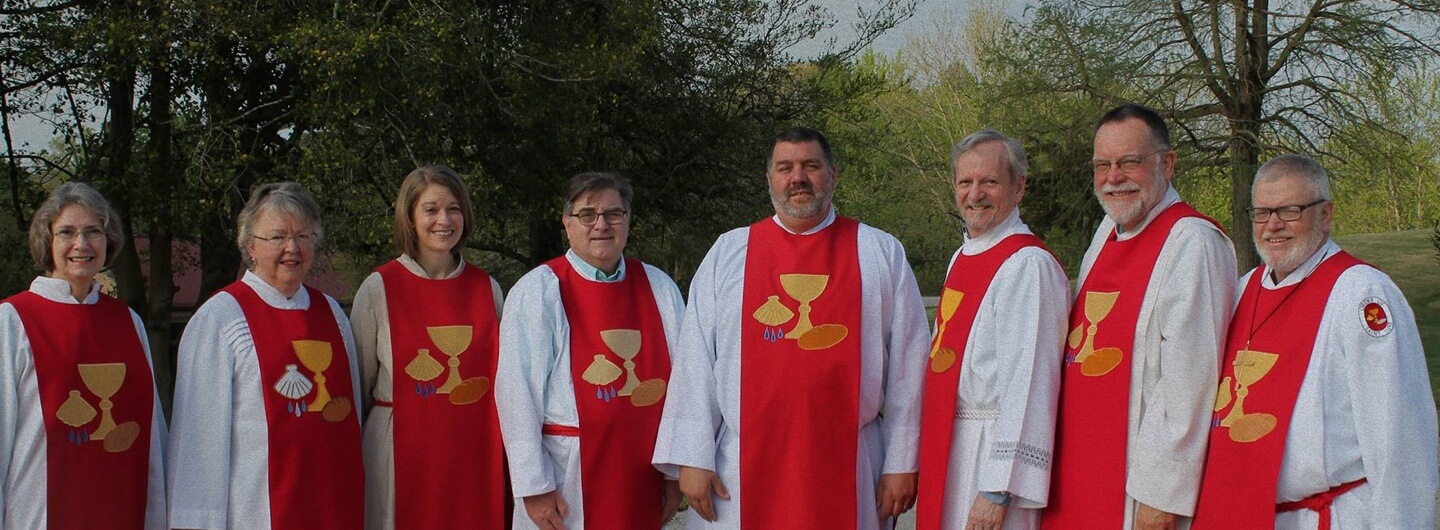
The habit of the Order of Saint Luke consists of an alb (either white or natural), a red cincture, and a red scapular with the emblem of the Order on it.
1.4.a) This habit was first worn by members of the Order and the general officers at the investiture of Brother Dwight as Abbot. It is not mandated, but commended to members of the Order, and has been widely accepted throughout the Order.
1.4.b) The alb is symbolic of the community of all baptized. Because of the emphasis Saint Luke the Evangelist places on the role of the Holy Spirit, the cincture and scapular are red. The cincture is a sign of the vows by which we bind ourselves to the Rule of Life and Service, but also of our need for the aid of the Holy Spirit in living out these vows. The scapular is the apron of a servant and symbolizes our commitment to servant ministry. It is worn by lay and clergy alike without distinction, thus symbolizing our shared ministry and mission.
1.4.c) The habit can be worn by members of the Order at services of the daily office, especially Morning and Evening Prayer and Vigil services. It is not usually worn when the mid-morning or midafternoon offices are prayed in a community space rather than a chapel, unless (at the option of the presider) one is leading the prayers of the community.
1.4.d) The habit is usually worn by members of the Order when sharing in the Eucharist in community, as well as at services of profession and investiture. Abbot Dwight wore the scapular when leading services of the Word, while Abbot Mark preferred to wear a stole. A chasuble is often worn over the scapular or stole by the presider when the Order celebrates Eucharist in community.
1.4.e) When an insignia of office is affixed to the scapular, it appears on the back side where it can be seen during the procession, but does not appear when the officer faces the community in the representative role of liturgical leader.
Day 22: 2) About Life in the Order
2.1) The Nature of Dispersed Community
The Order of Saint Luke is a dispersed community bound together by our common commitment to our Rule of Life and Service.
2.1.a) Because members of the Order are widely dispersed, the times when they are able to meet face to face are infrequent. Abbot Michael recognized that opportunities to meet together as chapters or associations and at the retreats or convocations of the Order each October are precious to our life together. Members are encouraged to participate when members of the Order gather in these expressions of our common life as frequently as possible.
2.1.b) Members of the Order who, because of geographical distance or health concerns, find it difficult to be present when members of the Order gather are encouraged to find ways of relating to their brothers and sisters in the Order through such means as having another member of the Order as a spiritual companion, participating in the cyber-chapter, and/or having regular communication with other members of the Order through e-mail, telephone, or letter.
2.1.c) Members of the Order have diverse ministries in diverse places. Both clergy and laity may find those ministries both within and beyond their occupation. Abbot Dwight noted that we share a vocation—our calling to live out the Rule of Life and Service–whatever our day to day work may be, and encouraged brothers and sisters in the Order to understand their life and work as expressions of the dispersed community that is the Order of Saint Luke.
2.1.d) Abbot Mark affirmed that the clearest manifestation of our common life, even when dispersed, is our daily prayer for and with our brothers and sisters in the Order (see 2.3 below).
Day 23: 2.2) Living the Sacramental Life
As members of the Order, we are called, individually and corporately, to live a sacramental life. Living sacramentally involves living out all of life through being in touch with sources of spirituality grounded in God’s grace, especially in the liturgy of the Church.
2.2a) Abbot Michael guided the order to recognize that, in addition to our concern for the liturgy of the Church, especially as manifested in the sacraments, members of the Order are called to sacramental living. He founded and edited Sacramental Life as a journal devoted to sacramental spirituality.
At their meeting at Maggie Valley, the Council of the General Chapter discussed in depth what this would mean and confirmed it as a key aspect of the Order’s life.
2.2.b) Using the Maggie Valley discussion as a base, Br. Dwight surveyed contemporary liturgical and sacramental theology for insights into the sacramental life. Presentations of his work led to further discussions at retreats of the Order, giving rise to Food for Pilgrims: A Journey with Saint Luke, which has become a basic study book for the Order.
2.2.c) Both Abbot Dwight and Abbot Mark noted that, as a part of living out our baptism eucharisticly, sacramental living recognizes the cosmos as itself a sacrament of God’s grace. Care for the natural world, care for the Church, care for our partners and our brothers and sisters in the Order, and self-care are all part of sacramental living. The liturgy of the Church, especially in its rites and sacraments, provides us with insights into a holistic approach to sacramental living.
Day 24: 2.3) Praying the Daily Office
Praying the Daily Office, and living so as to embody our prayers, is a communal act shared not only with our brothers and sisters in the Order, but with Christians around the world and through the ages.
2.3.a) Early in the life of the Order, the “green card rite” provided a form for members of the Order to pray the Daily Office. The Book of Offices and Services , developed by Br. Timothy Crouch, our Chaplain General, provided Orders for Morning and Evening Prayer and Compline. Abbot Michael directed Br. Dwight Vogel to coordinate the preparation of additional resources for the Daily Office relating it to the seasons and holy days of the Church year. Reflecting the work of more than a decade, the five volumes of The Daily Office: A Book of Hours for Daily Prayer after the Use of The Order of Saint Luke guide members of the Order in praying the Daily Office.
2.3.b) Two additional volumes are included in the series: The Daily Lectionary: A Guide for Using the Scriptures within the Daily Office, prepared by Br. Mark Stamm before he was Abbot, and For All the Saints, a sanctoral cycle originally prepared by Br. Clifton Guthrie. The earlier “green card rite” has been replaced by a “tan card rite providing an easily transportable rite in keeping with the Daily Office of the Order.
2.3.c) There are many resources for praying the Daily Office. Members of the Order are not obligated to use the form provided by the Order, although many do, finding in praying the offices provided by the Order a sense of connectedness with their brothers and sisters in the Order. However, the Daily Office should never be confused with “private devotions” that focus on individual prayer. The Daily Office is always the prayer of the Church, lifted up with and for the whole Church through the ages, even when prayed as a solitary act.
2.3.d) The Daily Office of the Order of Saint Luke includes the seven offices commended by Basil the Great in the fourth century: Evening Prayer (Vespers or Evensong), Compline (night prayer), Vigil, Morning Prayer (Lauds), and the three brief “diurnal” or daytime offices—mid-morning, mid-day, and mid-afternoon prayer. From these offices, Abbot Dwight advised, one selects those which will be most beneficial given the times and seasons of one’s life. That may change day to day, year to year. It is participating in the prayer of the Church that is important, he taught, not the number of offices prayed. However, he commended the praying of all seven offices from time to time, even if not all on the same day.
Day 25: 2.4) Convocations and Retreats
Members of the Order of Saint Luke are called to gather together annually at or near the Feast of Saint Luke to worship and pray together, share their joys and sorrows, learn from one another, and reflect on the vows they have taken.
2.4.a) From the early days of the Order, members of the Order have been called together once every four years in a convocation. While Michael was Abbot, the discernment of the General Chapter was that we needed to meet annually in retreat.
2.4.b) Although all retreats and convocations are open to anyone, retreats tend to focus more on the life and concerns of the Order, while convocations speak to the life of the denomination or the whole Church.
2.4.c) Retreats and convocations are under the overall supervision of the Abbot. The Abbot usually appoints a retreat master, who may or may not be one of the general officers. The retreat master in concert with the Chaplain General determines the schedule of offices and services. The Chaplain General is then responsible for the planning and execution of all offices and services, making use of a wide range of leadership.
2.4.d) Possible topics for retreats or convocations are shared at meetings of the General Chapter and the Council of the General Chapter. The topic is the result of the discernment of the Council guided by the Abbot.
2.4.e) It is customary for the Abbot to preside at the service of profession and, if an ordained elder, at the final Eucharist. Leaders of offices and services are encouraged to include the Abbot in appropriate ways throughout retreats and convocations.
2.4.f) At his first meeting as Prior General in 1996, Br. Mark Stamm recommended that national retreats be held in various regions. A national retreat was first held in California in 1999, and the practice of the Order has been to vary the geographical locations of retreats ever since.
Day 26: 3) About the Order’s Worship Life
3.1) Celebrating the Sacraments
In accordance with our vow to magnify the sacraments, the celebration of the Eucharist and renewal of the baptismal covenant are foundational whenever members of the Order gather.
3.1.a) From the time of Abbot Michael, it has been the custom for the Order to celebrate the Eucharist daily when gathered in convocation or retreat. Chapter meetings almost always include a service of Eucharist.
3.1.b) When the Order gathers, Eucharist may be combined with Morning Prayer, Evening Prayer, or Vigil or be observed as a Service of Word and Table apart from, or replacing, one of the offices. The inclusion of Eucharist in Services of Profession or Investiture is commended.
3.1.c) The renewal of the baptismal covenant became a part of the service of profession at retreats and convocations during Abbot Dwight’s tenure. Its inclusion at the beginning of Services of Profession or Investiture is commended to chapters of the Order.
3.1.d) A foundational study book for understanding the role of the Sacraments in the Order is Abbot Mark Stamm’s Sacraments and Discipleship: Understanding Baptism and the Lord’s Supper in a United Methodist Context .11
3.2) Use of the Daily Office
When members of the Order meet together, whether informally, as a chapter or association, or as a General Chapter, the use of the offices appropriate to the time of day of the meeting is commended.
3.2.a) At annual retreats or convocations of the General Chapter, it is our custom for each of the seven offices to be prayed at least once during the gathering.
3.2.b) The Vigil office usually replaces Evening Prayer if prayed in the early evening. It may also replace Compline at the direction of the retreat master or chaplain. As a late night office, it is prayed as an office in its own right.
3.2.c) The entire office of Compline is traditionally prayed while seated. At the conclusion of Compline, participants remain in silent prayer and meditation, leaving one by one as moved by the Spirit. Participants who leave maintain silence in and around the area in deference to those who remain in prayer.
3.2.d) Mid-morning and mid-afternoon prayer are usually prayed in the location in which the Order has been meeting rather than in the chapel. If mid-day prayer takes the form of a simple diurnal office, it is also prayed in the location of the meeting. However, if it is a more fully developed service, it is prayed in the chapel.
3.3) Liturgical Colors
The color appropriate to the day or season of the Church year is used for offices and services of the Order, except for those services related to the Order of Saint Luke and its patron.
3.3.a) Red is the appropriate color for all offices and services of the Feast of Saint Luke.
3.3.b) From the tenure of Dwight as Abbot, red has also been the liturgical color for services of profession and investiture.
3.3.c) White may be used at a service memorializing our departed brothers and sisters.
3.3.d) Daily offices do not require the use of a liturgical color, although it is appropriate to use the color of the day or season.
3.4) Processions
A procession is a sign of our pilgrimage of faith, our journey from birth to death, and our living into and out of our Rule of Life and Service.
3.4.a) Processions have frequently been a part of Services of Profession and Investiture at meetings of the General Chapter since the investiture of Dwight as Abbot.
3.4.b) Processions, under the direction of the Chaplain General, are led by the crucifer, followed two by two by members of the Order and their guests, followed by canons of the Order, the General Officers and the past Abbot(s), and finally by the current Abbot.
3.4.c) The crucifer stands at the head of the aisle facing the procession. Each pair first reverences the cross and Lord’s Table with a bow, steps apart to reverence with a bow the presence of Christ in each other, and then proceeds to their seats, remaining standing. Abbot Dwight began the tradition of making a profound bow to the community right and left, reverencing the presence of Christ in the community. Members of the community respond with a bow.
3.4.d) As an option, the Daily Office makes provision for the Great Litany to be prayed in procession. The petitions of the litany may be given by various members of the community.
3.5) The Abbot’s Commendation
The Abbot’s commendation is adapted from Acts 20:32: “And now I commend you to God and to the Word of God’s grace which is able to build you up and give you an inheritance with all the saints.” It is frequently followed by the Apostolic Blessing: “The grace of the Lord Jesus Christ, and the love of God, and the koinonia (or communion or fellowship) of the Holy Spirit be with you all.” (II Corinthians 13:14)
3.5.a) The Abbot’s commendation was first used at the investiture of Dwight as Abbot, and is used at the conclusion of the final service of a retreat or convocation.
3.5.b) As a sign of the pastoral role of the Abbot as chief shepherd of the Order, it is fitting to ask the Abbot to conclude the last office or service of each day at retreat or convocation with this commendation and blessing.
3.5.c) As a sign of unity with others in the Order, it is fitting at any service or office at which the Abbot or a past Abbot of the Order is present to ask one of them to give the community this commendation and blessing.
Day 27: 4) For the Good of the Order
4.1) Chapter and Association Life
Chapters meet to worship and pray together, share their joys and sorrows, learn about liturgical scholarship, education, and practice, and reflect on the Rule of Life and Service.
4.1.a) Members of the Order are encouraged to participate regularly in chapters. Where none exists, they are encouraged to form one. Where only a few members are present, they are encouraged to form associations.
4.1.b) Members throughout the Order answer the call to service by convening persons to form chapters or associations, facilitating regular meetings, and doing whatever it takes (often behind the scenes) to nourish and sustain the life of the Order. Sometimes they are officers; sometimes they are not. Such persons are a gift to the Order. Where they are present, the life of a chapter flourishes; without them, chapters wither and die. The Abbots of the Order join in commending their ministry to and for the Order.
4.1.c) The life of chapters and associations is supported by the Provincial General with whom chapters and associations should be in ongoing communication.
4.1.d) Abbot Dwight affirmed that the most important thing we do as members of the Order is to pray and worship together. Thus, praying the Daily Office and celebrating Eucharist are at the heart of chapter life.
4.1.e) The life and organization of chapters varies widely. Each chapter is encouraged to find the ways, means, and formats that serve them best, on a regularly scheduled basis discerning whose gifts will best serve the chapter as officers at that point in its life.
4.1.f) The Prior is the shepherd of the chapter. In discerning who should be prior, the chapter should ask: “who do we look to for spiritual as well as organizational leadership?” The Chancellor has the responsibility of maintaining the membership roll (including insuring that those taking vows locally have registered with the Chancellor General of the Order). Often there is a Sub – Prior who may be responsible for vocations (calling persons to life in the Order), or retreats and meetings. As with the General Chapter, the Chaplain is responsible for coordinating offices and services for the chapter, but does not always lead or preside.
4.2) Provincial Companions
Provincial companions seek to “walk with” all members of the Order in their spiritual journeys, with special attention to those who are not a part of a chapter or association.
4.2.a) In its early history, the Order was divided into “jurisdictions” following the same boundaries as those of the Methodist Church. The discernment of the Council was that such divisions were too large and impersonal and did not adequately reflect the needs and demographics of the Order. The General Chapter acted to replace jurisdictions with a larger number of provinces seeking to reflect more adequately the membership of the Order. Beginning with Abbot Mark, provincial companions have been named.
4.2.b) Provincial companions are encouraged to be in contact at least once a year with members of the Order with special attention to those who are not a part of a chapter or association. The basic question here is: “How is it with your journey as a member of the Order of Saint Luke?”
4.2.c) Provincial companions are also encouraged to contact lapsed members to invite them to renew their participation in the life of the Order.
4.2.d) Provincial companions are invited to be a part of meetings of the Council of the General Chapter. Some financial support is provided to enable their participation.
Day 28: 4.3) Council of the General Chapter
While it is always amenable to the General Chapter and reports to it, the Council of the General Chapter bears responsibility for the good of the Order, handling much of the ongoing business of the Order, as well as visioning for the Order and reviewing its health and welfare.
4.3.a) In order that meetings of the General Chapter may focus on key aspects of the Order’s life and not allow business to become dominant over the worship, sharing, and learning which are the primary concerns of the Order when it gathers, the Council seeks to serve the General Chapter, both by preparing for it, identifying those concerns which need its consideration and action, and by carrying out the will of the General Chapter, attending to the details of implementation.
4.3.b) This responsibility for the business of the Order is undergirded by the Council’s worship life together, as it prays the offices and celebrates the Sacraments with the guidance of the Chaplain General. The Abbot identifies the times for these offices and services while the Chaplain General coordinates the implementation of them.
4.3.c) The General Officers together bear responsibility for insuring that invitation to meetings of the Council is made known to all whose participation in it is provided for by the Constitution, encouraging the participation of as many members as possible. Hospitality from long standing members of the Council toward newcomers is a shared ministry, although one person may be designated to insure that such a ministry is carried out.
4.3.d) In order that the business of the Order not be focused on a continual revision of the Constitution and By-Laws, Br. French Ball was asked by Abbot Dwight to be “custodian” of possible changes throughout a four year period, and then to bring recommendations to the Council for action at the conclusion of that period. Under Br. French’s leadership, much material subject to ongoing change was placed in the by-laws where it can be revised more easily. Abbot Mark confirmed and continued that practice. It has thus become our custom to engage in constitutional revision infrequently.
Day 29: 4.4) The Role of the Abbot
The Abbot is the chief shepherd of the Order, overseeing the spiritual and material welfare of the Order and its members, serving as the key liturgical presider of its worship life, speaking the prophetic word of God to it, and calling all brothers and sisters in the Order to accountability before God for our Rule of Life and Service.
4.4.a) In earlier years of the Order’s life, its chief officer was known as the Dean (following the example of English cathedral chapters) or president (with emphasis on the role of presiding). The decision, during Michael’s tenure, to call our leader “Abbot” appropriated a title from the monastic religious tradition. The Abbot, who answers this call to service from his brothers and sisters in the Order, is more than a presiding officer. As our father (or mother) in Christ, the Abbot’s chief responsibility is for the good of the Order and all its members. The Abbot, thus, is pastor, priest, and chief administrator of the Order.
4.4.b) When the Abbot presides at meetings of the General Chapter or its Council, generally accepted procedures of parliamentary procedure are used when appropriate. However, the Abbot has the responsibility, from time to time, to speak to the matter at hand for the good of the Order without relinquishing the chair.
4.4.c) The Abbot may also ask for the consent of the body (without taking a formal vote) by inviting the members of the body to say “Agreed.” In the absence of hearty approval, the Abbot will return the matter to the floor for further discussion or table it for later consideration.
4.4.d) The gift of wisdom regarding the good of the Order is not manifested solely in those holding regularly elected or appointed offices. The Abbot appoints such persons to be “Canons of the Order.” Canons of the Order serve as members of the Council of the General Chapter. The first canons were named jointly by Abbot Dwight and Abbot Mark in 2000.12
4.5) The Abbot’s Cathedra
The sign of the Abbot’s cathedra (or chair) is a textile hanging portraying the ox from the Book of Kells, symbolizing Saint Luke.
4.5.a) Traditionally, the chair of an Abbot or a Bishop has been known as a “cathedra.” Since the Order of Saint Luke is a dispersed order, worshipping and meeting as General Chapter and its Council in varied and geographically diverse places, a “portable” sign for the Abbot’s chair was needed.
4.5.b) At the request of Br. Dwight, Br. Bill Doser designed and crafted a textile cathedra, using the ox from the Book of Kells. It was first used by Abbot Michael at the installation of Br. Dwight as Abbot.
4.5.c) Since that time, it has always been used on the Abbot’s chair at services of investiture and services of profession, as well as when the Abbot is the eucharistic presider.
4.5.d) It is appropriate to use the cathedra for the Abbot’s chair at meetings of the General Chapter and its Council and in prayer and worship at the offices and services of the gathered community.
4.5.e) At meetings of the General Chapter or its Council, it has been placed either on the back of the chair in which the Abbot sits or on the table in front of the Abbot.
4.5.f) It is the sign for the office of Abbot and not of the presider of the meeting, or of the worship leader. It may be placed on the back of the pew or chair where the Abbot sits, wherever that is in the gathered community when it meets for prayer and worship. If the Prior-General or some other person is officiating at a meeting, it is on the chair where the Abbot sits (if present), and not used on the chair of the presider. In the absence of the Abbot, it may be placed on the back of an empty chair.
4.5.g) As a portable sign of the unity of the Order with the Abbot, it may be used anywhere throughout the Order when the Abbot is present. It is also appropriate for the Abbot to use it personally as a reminder of the call to service he or she has answered
4.6) Calling for the Discernment of the Abbot
When a matter of great significance faces the Order and the discussion is not yielding a conclusion after much consideration, a member of the body may call for the discernment of the Abbot.
4.6.a) Br. Dwight recalls that at the convocation in Kansas City13, the possible investment of the Order in a retreat center to serve as a “mother house” and center for the Order evoked passionate expressions on both sides of the question. Someone called for “the discernment of the Abbot.” The house fell silent. Abbot Michael, after a moment of prayerful reflection, indicated that it was his discernment that the Order should not proceed with the project at that time. There was another brief silence and the General Chapter then moved on to other business.
4.6.b) A call for the discernment of the Abbot is rare. It should not be used as a means of bringing about what one wants. It is an invitation to the Abbot as the spiritual and temporal guide of the Order to show us a way.
4.6.c) The Abbot may decline the invitation if it is felt that the request is untimely, or if the Abbot does not feel led by the Spirit to a discernment that is for the good of the Order.
4.6.d) In reflecting on the Kansas City event, past Abbot Dwight realized that it is possible, though unlikely, that someone in the body could appeal the Abbot’s discernment. It would be wise at that point for the Prior-General to take the chair, calling for a time of prayer. The question would then be put to the body: “Will you affirm the Abbot’s decision? If so, raise a hand. . . If not, raise a hand.” If the Abbot’s discernment is affirmed, it becomes an official action of the body. In either case, the Abbot then resumes the chair and seeks to carry out the discernment of the body for the good of the Order.
Day 30: 4.7) For the Good of the Order
The good of the Order is characterized by our Rule of Life and Service and our apostolate of liturgical scholarship, education
4.7.a
The Abbot and other general officers are responsible before God and to their brothers and sisters for the good of the Order. If they prayerfully discern together that some procedure, or the actions of a person or persons is harmful to the good of the Order, they consult together about how to address the matter with both firmness and compassion.[8]
4.7.b The General Chapter and the Council of the General Chapter seek to carry out their responsibilities for the good of the Order. From time to time they are encouraged to pause for prayerful reflection on their stewardship of that commission.
4.7.c Priors and provincial companions are encouraged to continually reflect upon their ministry in light of the good of the Order and to engage in fruitful action to fulfill it.
4.7.d All members of the Order of Saint Luke bear responsibility not only for their own spiritual journey as members of the Order, but also for the good of the Order as a whole, that in all Christ may be glorified and Holy Church strengthened for the sake of the whole world.
Day 31: APPENDIX 1
Policies and Traditions Regarding Life Vows
(Presented by Abbot Daniel, amended and adopted at the meeting of the Council of the General Chapter on May 1, 2009. As Br. Abba Dwight reminds us, our understanding of life-vows and the traditions around them has an ongoing life.)
- The Order of Saint Luke established Life Vowed membership in 1995. We made the decision with the clear understanding that in doing so, we would avoid creating a hierarchy, with life vows being somehow superior. Life Vowed members are different, but one is not superior to Annual Vowed members. This is evident in our polity. For instance, one can hold any office in the Order (including Abbot) as either a life vowed or annually vowed member.
While life-vowed members and annually-vowed members are all fully part of the Order, there are some emerging traditions specific to life-vowed members.
Shared Accountability: It is strongly encouraged that life-vowed members annually engage in conversation with another life-vowed member with regard to each other’s accountability to the Rule of Life and Service.
- Entry into discernment toward life vows: Persons can enter discernment for Life Vows after living under annual vows for three years. Members seeking to enter discernment begin the process by writing to the abbot stating their request to move toward Life Vows. The Abbot confirms with the chancellor that the prospective Life Vow discerner has been under annual vows for three consecutive years. The chancellor communicates what the paper file shows, though the Abbot interprets that information as s/he sees fit.
- The Prior of Life Vowed Members
The Prior for Life Vowed Members appoints a “companion” for those discerning a call to life vows. The Prior for Life Vowed Members is an abbatial appointment.
- Companions for Life Vowed Members
Companions for those seeking and discerning Life Vows have, traditionally, been members of the Order who are Life Vowed. The abbot or the Prior for Life Vowed Members assists the discerner in selection of a companion.
- Course of Discernment:
The abbot sets and guides the process and steps of discernment, in consultation with the Council and the Prior of Life Vowed Members. Central to the discernment process is the rite of profession itself.
The questions to which the discerning member will be responding in the rite form the horizon of discernment and serve as a guide to self-examination over the period of discernment. The final work of discernment is preparation of a testimony of journey, which covers both the life long journey of faith and in particular narrates the relationship with the Order of Saint Luke and the intention to live in a life vowed relationship. Other recommended steps in the process may include but are not be limited to:
- Keeping a journal recording the journey toward life vows and the deepening of the meaning of the Order in one’s life
- Engage in directed reading or other explorations
- In late summer write the abbot a letter to sharing the sense of readiness for life vows
- Participate with the abbot in conversation and mutual discernment of readiness
- Prepare a witness or story of your decision, including the ways that you will live out the RLS as a life vowed to be shared with the community during the service of profession at the Order’s annual retreat.
- Profession of Life Vows
Life Vows are professed during the Service of Profession at the Order’s retreat or convocation.
- As with annually vowed members, there is no explicit connection between annual dues or gifts to the Order and life vowed membership.
- Roll of Life Vowed Members
The Chancellor General maintains a roll of life vowed members
“A Calendar of Readings— A Month of Readings for Inquirers” (inclusive of The Rule of Life and Service, The Constitution of the Order of Saint Luke, and The Customary) © 2000, 2010, 2017, 2018 The Order of Saint Luke.